

IECC Logo
SHRAM: System for Heat Risk Assessment for Manual labor

Current Heat Stress Alerts MET LEVEL CONDITIONS STATE
All India
DISTRICT
All Districts
MET Level: Select based on work intensity.
• EHI-3: Light (walking, light housework)
• EHI-4: Moderate (carrying loads, cleaning)
• EHI-5: Heavy (construction, farming)
• EHI-6: Very Heavy (agricultural labor, heavy lifting)

Sun Exposure:
Shade: Working under cover or indoors
Sun: Direct sunlight exposure

Loading current status...

Data source: India Meteorological Department (IMD)

Heat Stress Forecast MET LEVEL CONDITIONS FORECAST MET Level: Select based on work intensity.
• EHI-3: Light (walking, light housework)
• EHI-4: Moderate (carrying loads, cleaning)
• EHI-5: Heavy (construction, farming)
• EHI-6: Very Heavy (agricultural labor, heavy lifting)

Sun Exposure:
Shade: Working under cover or indoors
Sun: Direct sunlight exposure

Click on a state to select it:

Loading forecast...

Data source: Open-Meteo | Methodology

Historical Zones TIMEFRAME MET LEVEL CONDITIONS STATE
All India
DISTRICT
MET Level: Select based on work intensity.
• EHI-3: Light (walking, light housework)
• EHI-4: Moderate (carrying loads, cleaning)
• EHI-5: Heavy (construction, farming)
• EHI-6: Very Heavy (agricultural labor, heavy lifting)

Sun Exposure:
Shade: Working under cover or indoors
Sun: Direct sunlight exposure

Historical Zones

Dry-Bulb Temperature & Relative Humidity

Data source: India Meteorological Department (IMD)

Historical Pre-Monsoon Season Zones

Historical hourly heat stress zones across India from April through June. Use the controls to change MET level, sun/shade conditions, and scrub through time.

Data source: ERA5 Reanalysis (Copernicus Climate Data Store)

Calculate EHI-N*

Select Activity Level (METs)

3 METs
Light Work
4 METs
Moderate Work
Heavy Work
5 METs
Heavy Work
6 METs
Very Heavy

About EHI-N*

The Extended Heat Index for Laboring Populations (EHI-N*) is a physiologically-based heat stress metric designed to assess thermal stress in labor-intensive occupations.
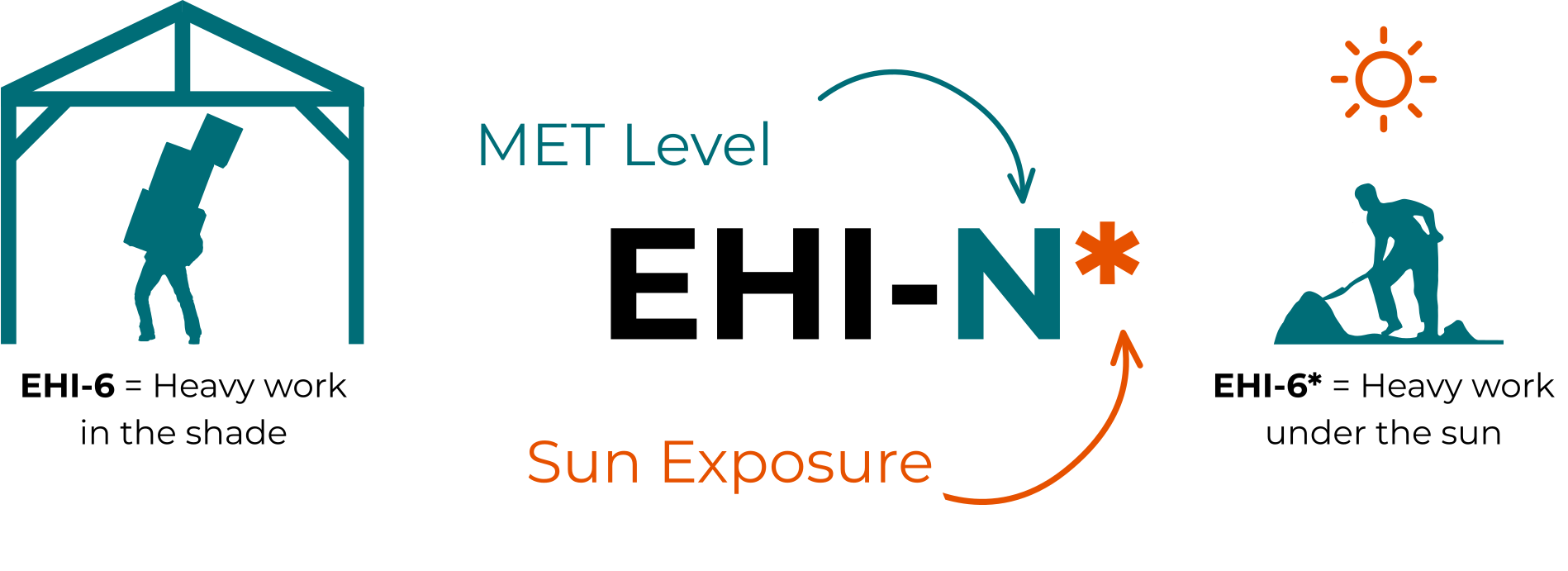
EHI-N* Nomenclature: N indicates metabolic rate (3-6+ METs), * indicates sun exposure

Scientific Foundation

Heat Stress Zones

EHI-N* classifies heat stress into zones based on physiological risk:

Zone 6: Hyperthermia (Severe Heat Stress)

Physiological State: Core temperature rising - Heat production exceeds dissipation capacity.

Characteristics: All thermoregulatory mechanisms exhausted. Core body temperature is actively increasing, leading to heat illness.

HAZARDOUS - IMMEDIATE ACTION REQUIRED: Cease work immediately. Move to cool environment. Seek medical attention. Risk of heat stroke and organ damage.

Subscribe to Heat Stress Alerts

Get notified when hazardous heat stress conditions are detected in your location. Free service for workers, employers, and community organizers.

How does alerting work?

* Required fields. If no MET level or zone alert is selected, you will receive Zone 6 alerts for all activity levels.

SMS alerts coming soon

Hold Ctrl/Cmd to select multipleTap to select/deselect multiple
Default: EHI-6 for manual laborers. Select multiple if needed.
Default: Zone 6 only. Receive alerts when conditions reach these zones.
Default: Sun. Select based on your typical work environment.

Contact

India Energy & Climate Center (IECC)
University of California, Berkeley

iecc@berkeley.edu
iecc.gspp.berkeley.edu

API Documentation

Access real-time heat stress data programmatically through our API.

Get Current Alerts

https://iecc-io.github.io/SHRAM/weather_logs/latest_alerts.json

Returns: Current heat stress zones for all Indian districts

Get 24-Hour History

https://iecc-io.github.io/SHRAM/weather_logs/alerts_24h.json

Returns: Hourly data for last 24 hours with zone distributions

Get 3-Day Forecast

https://iecc-io.github.io/SHRAM/weather_logs/forecast_data.json

Returns: 72-hour heat stress forecast with EHI predictions

Get Weekly Trends

https://iecc-io.github.io/SHRAM/weather_logs/trends_weekly.json

Returns: Last 4 weeks of daily zone averages

Get Monthly Trends

https://iecc-io.github.io/SHRAM/weather_logs/trends_monthly.json

Returns: Last 6 months of weekly zone averages

Example Usage (Python)

import requests
import pandas as pd

url = "https://iecc-io.github.io/SHRAM/weather_logs/latest_alerts.json"
data = requests.get(url).json()

df = pd.DataFrame(data['alerts'])
print(f"Zone 6 (hazardous): {data['zone_6_count']}")

hazardous = df[df['Hard Labor Heat Stress Zone'] == 'Zone 6']
print(hazardous[['DISTRICT', 'STATE', 'EHI_350 (in shade °C)']])

Privacy Notice

Your contact information will only be used to send heat stress alerts. We will never share your data with third parties. You can unsubscribe at any time.